
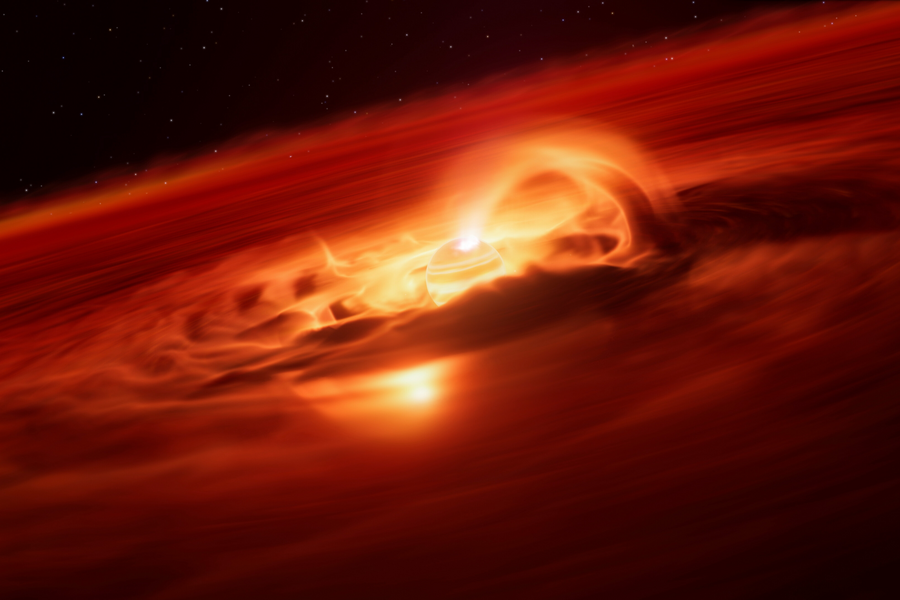
A rogue planet, drifting alone in the vastness of space without a host star, has captured astronomers’ attention for its astonishing growth rate. Scientists have recently observed that this unusual celestial body is accumulating mass at a staggering rate of 6 billion tonnes per second, setting a new record in planetary science.
Rogue planets are enigmatic objects because they do not orbit any star and instead wander through the galaxy independently. This particular rogue planet’s rapid growth challenges previous assumptions about such bodies, suggesting they can still attract and absorb substantial amounts of material despite their isolation. The source of the accumulating mass is believed to be interstellar gas and dust, which the rogue planet’s gravity pulls in as it travels through denser regions of space.
The implications of this discovery are significant for our understanding of planetary formation and evolution. Traditionally, planets are thought to form and grow within the protective environment of a stellar system, where a protoplanetary disk supplies the necessary material. However, ongoing accretion in a rogue planet suggests that planet-formation processes could continue or even restart outside such environments. This could lead to the formation of more massive planets independently or to the transformation of smaller rogue bodies into different types of astronomical objects.
Astronomers are also keen to study how such rapid mass gain might affect the rogue planet’s atmosphere, composition, and internal structure. As it grows, the planet could develop stronger magnetic fields or even ignite processes similar to those occurring in stars or brown dwarfs. Observing these phenomena in real time offers a unique window into planetary dynamics in the absence of a star, a scenario rarely accessible through current observations.
The discovery prompts new questions about the frequency and characteristics of rogue planets in the galaxy. It raises the possibility that many could be more dynamic and evolving than previously thought, playing an unexpected role in the ecosystem of our galaxy. Researchers are now planning further targeted observations using space telescopes and radio arrays to track this planet’s growth and investigate how common such rapid accretion events might be among other rogue planets.
Understanding the behavior of this record-breaking rogue planet not only expands our knowledge of planetary science but also enriches our grasp of the diverse and sometimes surprising mechanisms that shape the cosmos.