
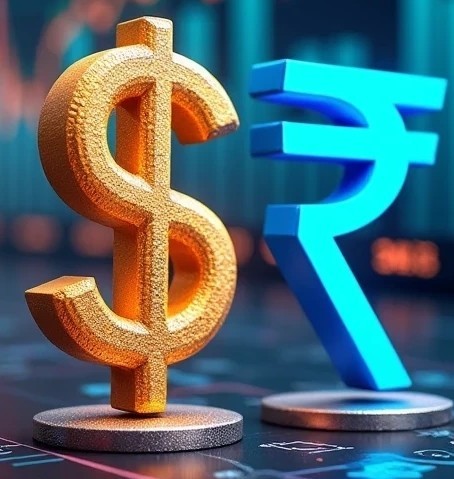
Mumbai, December 3, 2025 – In a stark reminder of the vulnerabilities facing emerging market currencies, the Indian rupee plunged to a historic low of 90.13 against the US dollar in early trading today, breaching the psychologically significant 90-mark for the first time. The currency closed the session at 90.3340, down 0.46% from Tuesday’s levels and extending its year-to-date depreciation to over 5%. This slide, the steepest annual drop since 2022’s geopolitical shocks, has overshadowed India’s robust economic growth and raised alarms about the nation’s external balances.
The rupee’s descent comes just days before the Reserve Bank of India’s (RBI) monetary policy decision on December 5, with markets bracing for potential interventions to stem further erosion. While the central bank has already deployed sporadic dollar sales to defend the 90 level, analysts warn that without swift progress on stalled US-India trade talks, the currency could test 91 by year-end.
Roots of the Rout: Trade Stalemate and Outflows
At the heart of the rupee’s woes is the protracted absence of a bilateral trade agreement with the United States, a key export market for India. Negotiations, which raised hopes of tariff relief last month, have hit repeated snags under the Trump administration’s aggressive stance on global trade. In late August, the US imposed a 50% tariff on most Indian exports—the highest levy on any Asian nation—alongside a 25% secondary penalty tied to India’s trade with Russia. This has slashed exports to the US by 28% since May, dragging the merchandise trade deficit to a record $41.7 billion in October.
Compounding the trade imbalance, foreign portfolio investors (FPIs) have yanked nearly $17 billion from Indian equities year-to-date, with $4,335 crore ($425 million) offloaded in the first two days of December alone. This capital flight, driven by global risk aversion and a hawkish outlook from the US Federal Reserve, has boosted dollar demand from importers and corporates. “The rupee’s breach past 90 reflects tariff-driven sentiment rather than fundamental decay, but the underlying imbalance between dollar supply and demand persists,” noted Abhishek Goenka, CEO of FX advisory firm IFA Global.
India’s voracious appetite for imports—particularly oil and gold—has further fueled the deficit. Gold inflows tripled to $14.7 billion in October, while volatile crude prices, hovering around $67 per barrel, continue to strain forex reserves despite a 14.6% drop from mid-year peaks. These pressures have eclipsed positive domestic indicators, including an 8.2% GDP expansion in Q2 FY26—the strongest in six quarters—that propelled benchmark indices like the Sensex to fleeting record highs earlier this week.
Ripple Effects: From Wallets to Balance Sheets
For the average Indian, the rupee’s tumble translates to pricier essentials and dreams deferred. Fuel costs, already elevated by import dependence, could rise further, adding 30-35 basis points to headline inflation for every 5% depreciation, per RBI estimates. A weakening currency exacerbates the current account deficit, projected to widen amid subdued export growth, and hikes the cost of overseas education and travel, critical for millions of middle-class families.
Exporters, however, may find a silver lining: a cheaper rupee enhances competitiveness, potentially offsetting tariff hits and boosting labor-intensive sectors like textiles and gems. Yet for debt-laden firms with dollar obligations, the pain is acute—servicing costs rise, squeezing margins amid elevated US yields.
The equity markets echoed the gloom today, with the Sensex dipping 300 points to 85,350 as foreign selling spilled over. Government bonds fared no better, with the 10-year yield climbing to 6.553%, its highest in weeks, as hopes of a rate cut dimmed amid the growth-inflation tug-of-war.
Central Bank’s Tightrope and Global Backdrop
The RBI faces a delicate balancing act. Having eased rates by 100 basis points earlier in 2025, most economists anticipate a 25-bps cut on Friday to support growth, though the rupee’s frailty might prompt a pause. Reserves, still robust at $698 billion as of early September, have been drawn down by over $30 billion since July to blunt volatility. Still, forward premiums signal market bets on further weakening to 91.30 by end-2026.
Globally, the rupee’s plight mirrors broader emerging market strains. A resurgent US dollar—bolstered by sticky inflation and delayed Fed cuts—has pummeled Asian peers, though the INR ranks as the region’s weakest, trailing even the Turkish lira. Structural headwinds, such as India’s persistent trade deficits and higher domestic inflation (versus the US), are perpetuating the downtrend, with the real effective exchange rate dipping into undervalued territory for the first time in years.
Glimmers of Hope Amid the Storm
Optimism hinges on diplomatic breakthroughs. Commerce Secretary Rajesh Agarwal hinted at a framework trade deal by December’s end, potentially easing tariffs and unlocking inflows. Moody’s forecasts 7% GDP growth in 2025, outpacing peers, while AI-driven investments could fortify resilience. Exporters hedging more aggressively and banks offloading dollars have offered fleeting support, as seen in today’s mild regional currency rebound.
Yet, as the rupee flirts with uncharted lows, the narrative shifts from growth triumph to external fragility. For policymakers, the imperative is clear: fortify trade ties, curb gold fervor, and signal forex resolve to restore confidence. Without it, 90 may prove not a floor, but a fleeting milestone in a longer slide. As one trader quipped, “The rupee’s not drowning—it’s just learning to swim against the tide.” Investors, however, would do well to keep life jackets handy.